
A cheap-looking fare is not always a deal. When I check a flight price, I look at three things first: how it compares with the route’s past prices, whether it fits the season, and where it sits in the usual booking window.
Here’s the short answer: if a fare is near the low end of its 90-day range, matches a route’s normal low price, and falls in a common booking window like 1–3 months before domestic trips or 2–8 months before international trips, I’d book it. If it’s only average, I’d track it. If it’s high, I’d wait.
I’d use this simple checklist:
- Check Google Flights to see if the fare is labeled low, typical, or high
- Compare the usual range for that route, season, and airport
- Use the Date Grid and Price Graph to test cheaper days
- Check nearby airports like JFK vs. EWR or SFO vs. OAK/SJC
- Set fare alerts to watch the recent average and recent low
- Watch fees because a low base fare can grow after bags and seats
- Book when the fare is near the route’s floor, not just when it “looks cheap”
A few numbers help. Midweek flights can run about 13% less than weekend trips, and Wednesday can save about $56 on a domestic ticket. For rough benchmarks, a solid short domestic roundtrip often lands around $150–$250, coast-to-coast trips around $250–$400, and U.S. to Europe around $600–$900. Prices much lower than those ranges deserve a close look.
My rule is simple: don’t judge a fare by the number alone. Judge it by history, season, airport options, and timing. That gives me a much better read on whether to book now or hold off.

Use Google Flights to Check Whether Today’s Fare Is Low, Typical, or High
Google Flights is a quick gut-check for the fare you see today, helping you find cheap flights by comparing current prices to historical data. It shows whether that price sits below, within, or above the route’s usual range. Then you can compare that result with the target price you set earlier.
Read the Price Insight Banner and Typical Fare Range
After you search for a route, Google Flights shows a price insight banner near the top of the results. That banner labels the current fare as low, typical, or high based on what travelers have paid for similar trips on that route.
It also shows a price range, like $245 to $415, so you can see where the fare lands compared with what people usually pay for that itinerary. If today’s fare is close to the bottom of that range, that’s a strong sign the deal may be worth taking.
The banner can also tell you when prices have usually been lowest for similar trips, such as about two months before departure. That gives you a better read on whether to book now or wait a bit.
Use the Date Grid and Price Graph to Find Cheaper Travel Days
If the banner puts the fare in a gray area, check the calendar tools next. For flexible trips, the Date Grid and Price Graph can save you money fast. The grid shows the cheapest date pairs, while the graph shows the cheapest weeks.
Sometimes moving a flight by just a day or two is enough to drop the fare. Monday through Wednesday flights average 13% less than weekend travel, and Wednesday can save about $56 per domestic ticket.
Check Nearby Airports to Confirm Whether the Price Stands Out
If the fare still looks low, compare nearby airports before you book. One airport can come in far below the others, and that can change the whole math of the trip. Google Flights lets you search up to seven departure and arrival airports at once.
For example, if you’re flying out of New York, add EWR alongside JFK. If you’re heading to the San Francisco area, check OAK and SJC along with SFO. If one airport comes in much cheaper, look at the full trip cost, not just the ticket price. Ground transit can eat into the savings. City-wide airport codes like NYC or WAS make this comparison faster.
| City | Primary Airport(s) | Nearby Airports to Check |
|---|---|---|
| New York City | JFK, LGA | EWR |
| San Francisco | SFO | OAK, SJC |
| Los Angeles | LAX | BUR, SNA, LGB |
| Washington, D.C. | IAD, DCA | BWI |

Track Fare Alerts to Learn the Real Low Price for a Route
One search only shows today’s fare. That’s useful, but it doesn’t tell you if the price is close to the route’s low point or just a short dip. Fare alerts fill in that gap.
After using Google Flights, set alerts to see whether your target price is even in reach. That extra history helps you avoid chasing a number that looks good on paper but almost never shows up.
How Alerts Show the Lowest Prices a Route Actually Reaches
Use alerts to test the target price you set earlier. Over a few weeks, they show the route’s normal price range and give you three helpful markers: the recent average, the recent low, and the usual seasonal range.
That context matters. A fare drop can look tempting at first glance, but the history tells you whether it’s a book now moment or more of a wait-and-see price.
The main thing to watch is how far the fare falls below the recent average. Once you know where the route’s floor tends to sit, it’s much easier to tell whether a new alert is worth acting on or just background noise.
How Dollar Flight Club Helps You Spot Standout Deal Prices
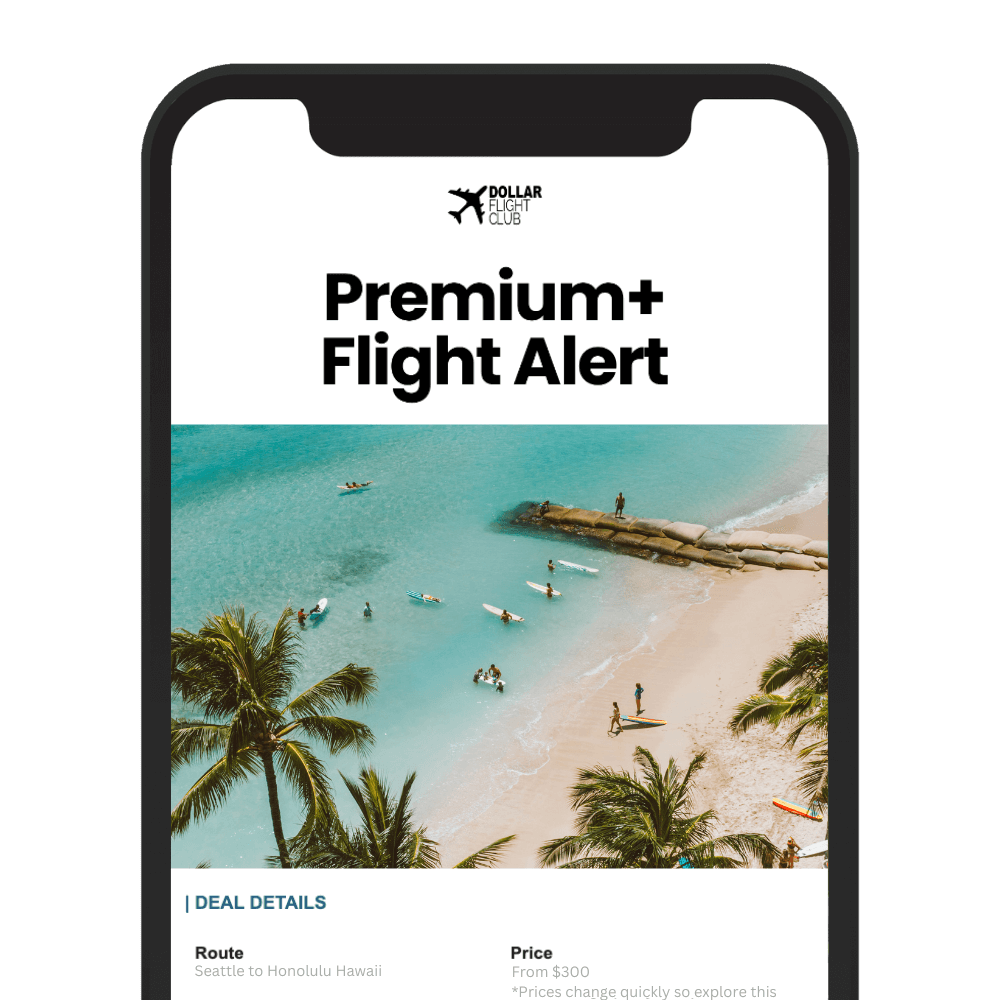
Dollar Flight Club sends email and SMS alerts for discounted flights, including mistake fares and deals up to 90% off. That gives you a fast way to spot a price that looks unusually low.
Then compare that alert with the route’s recent average and recent low. If the new fare lands well under the usual range, you may be looking at a deal worth jumping on. Use those alert lows to judge the route ranges below.

Benchmark Price Ranges for Common Domestic and International Routes
The numbers below are benchmarks, not hard rules. Think of them as a quick gut check before you compare live fares. A low base fare can stop looking cheap once bag and seat fees show up. So if a live price falls near the low end of these ranges, it deserves a closer look.
Use these ranges after checking Google Flights and fare alerts.
| Route Type | Good Roundtrip Range (USD) | Exceptional Deal Range (USD) | Notes |
|---|---|---|---|
| Short Domestic (under 3 hrs, e.g., NYC–MIA) | $150 – $250 | Under $100 | Watch for carry-on fees that can erase savings. |
| Coast-to-Coast (e.g., JFK–LAX, NYC–SFO) | $250 – $400 | Under $200 | Typical nonstop fares on JFK–LAX cluster around $298. |
| U.S. to Europe (economy, major gateways) | $600 – $900 | Under $500 | Summer fares run about 22% higher year-over-year. |
| U.S. to Mexico/Caribbean | $300 – $500 | Under $250 | Peak demand runs January–February. |
| U.S. to Asia | $700 – $900 | Under $600 | Plan 4–10 months ahead for peak periods like Lunar New Year. |
Short Domestic and Coast-to-Coast U.S. Routes
For short flights under three hours, under $100 roundtrip is a standout fare. The $150–$250 range is still solid, but it is more “good deal” than “drop everything and book.”
Coast-to-coast routes, like New York to Los Angeles or San Francisco, usually offer the best value in the $250–$400 range. If you spot a fare at around $200 or less, that is the kind of price that stands out. This gives you a simple way to tell the difference between a normal fare and one that is well below what you’d expect.
U.S. to Europe and Other Long-Haul International Routes
For economy flights to Europe from major U.S. gateways, $600–$900 roundtrip is often competitive. If the fare drops under $500, that is the sort of deal many travelers wait for.
For longer international trips, these ranges help set expectations before you decide whether to book or hold off for a better fare.

Compare Against Seasonal Averages and Decide Whether to Book Now or Wait
How Peak, Shoulder, and Off-Peak Seasons Affect What You Should Pay
Season shifts the baseline. That means the exact same fare can feel cheap in one month and completely normal in another.
Summer travel, Thanksgiving, Christmas, and spring break tend to push fares up. In fact, peak summer fares are up 24% year over year in 2026. So if you’re looking at peak dates, you need to judge the price against a higher baseline than you would for an off-peak trip. Without that context, it’s easy to think a fare is a deal when it’s just average for that time of year.
Shoulder seasons, such as late January, February, and late August, often hit a sweet spot with lower prices. If your schedule has some wiggle room, shifting your trip outside a peak window can make a meaningful difference in what you pay.
Book Now If the Fare Is Near the Route’s Low End; Wait If It Is Only Average
The booking window helps you figure out whether a fare is close to its low point. Start by checking where today’s price sits in your route’s 90-day price history. A simple way to size it up:
| Pricing Level | What It Means | Recommended Action |
|---|---|---|
| Low (bottom 25% of history) | Fare is in the bottom 25% of the route’s 90-day history | Book now – these fares rarely drop further |
| Typical (near the median) | Fare is average for the route and dates | Wait and track if your dates are flexible |
| High (top 25% of history) | Fare is in the top 25% of the route’s 90-day history, usually 18%+ above the median | Wait – set alerts and compare nearby airports |
Here’s the short version: if the fare is near the low end for that route, don’t overthink it. If it’s sitting around the middle, you may have room to wait or consult expert tips for finding cheap flights. If it’s high, step back and track it.
Best fares often show up 1–3 months before domestic travel and 2–8 months before international travel. For peak seasons, start earlier.

Conclusion: Use History, Alerts, and Seasonality to Confirm a Good Deal
A fare only counts as a good deal when it checks a few boxes at once. It should be low compared with the route’s price history, make sense for the season, and fall into the benchmark range for that route type.
Put those signals together. Use route history, seasonal timing, and alerts side by side: book when a fare lands near the route’s low end, wait when it sits in the middle, and pass when it’s high.
FAQs
What fees should I check before booking a cheap fare?
Don’t stop at the base ticket price. First, check whether the fare is basic economy. These tickets often come with limits on seat selection, carry-on bags, and changes or cancellations.
Then look at the extra fees. Baggage charges and seat assignment costs can add up fast. You’ll also want to watch for itineraries that make you self-transfer luggage or switch between different airports in the same city.
How long should I track a flight before deciding?
Watch a flight for a few weeks first. That gives you a clearer sense of what the price is doing: going up, bouncing around, or slowly dropping.
For domestic trips, the sweet spot is usually 1 to 3 months before departure. For international trips, it’s often 2 to 8 months out. Try not to hold out for a last-minute deal. In many cases, fares jump hard during the final 3 weeks.
If a ticket lands within your budget, book it. Then keep an eye on the price afterward in case you can rebook and get a flight credit.
Does booking one-way flights ever beat roundtrip prices?
Yes. Two one-way flights can sometimes cost less than a standard round-trip ticket.
This can work well when you mix and match airlines for your departure and return flights. One airline might have a lower fare on one leg, while another has the better deal on the other. Round-trip bookings are often easier to manage, but it’s still smart to compare both options and see which one gives you the lowest total price.