
Overview
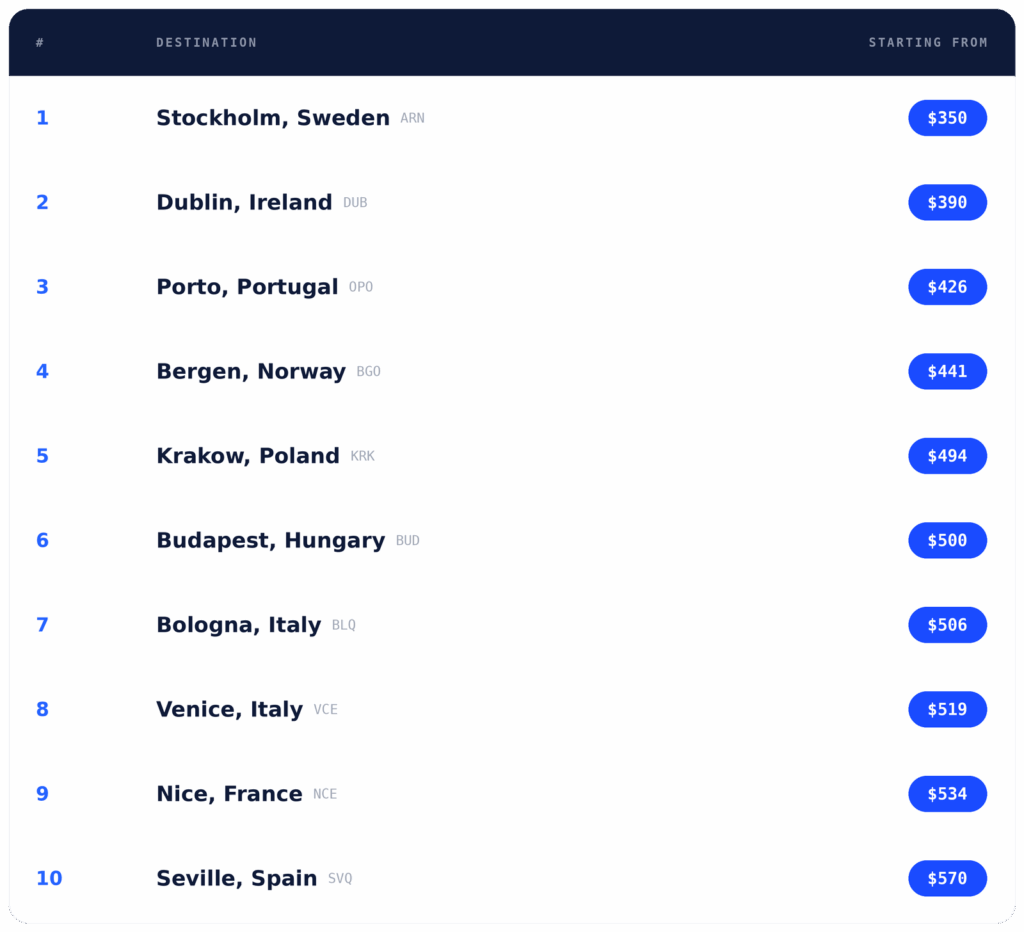
Peak summer fares to Paris, Rome, Barcelona, and London are running $1,700 to $2,100 roundtrip. That’s roughly 20% higher than last summer, driven by the fuel and capacity shock that followed the Iran war. Oil has actually started easing over the past few weeks as ceasefire talks progress, but those savings haven’t reached peak-summer transatlantic fares yet as airlines that already cut routes are slow to add them back. The gap to secondary cities is still wide open. But there’s still some opportunity to get to Europe on a budget right now if you know where to look. Cities with fares in the $350-$570 range who actually have fewer crowds and flights that cost a third of what you’d pay to major spots.
1. What's Actually Happening With Europe Pricing Right Now
The Iran war changed everything overnight. Jet fuel spiked sharply after the war began in late February, with oil hitting 2026 highs by mid-spring. Transatlantic routes got hit hardest because they burn the most fuel per seat.
Airlines responded the way they always do when costs spike. They cut capacity and raised fares. United trimmed 5% of flights through the next six months. Delta cut 3.5%. European carriers like KLM, Lufthansa, and Cathay Pacific all pulled flights. When airlines cut flights, they cut the unprofitable routes first like redeyes, midweek flights, and long-haul international ones. The routes that survive are the ones with strong demand.
The interesting part is that the fare increases aren’t hitting everything evenly. Western European capitals with massive demand are seeing 20%+ increases because airlines know people will pay, but secondary cities in Northern Europe and Eastern Europe, are holding much steadier because demand’s softer and low-cost carriers are still competing hard on price.
Summer domestic fares are up 10-15% across the board and transatlantic to the big cities is up 20%. But if you know where to look, there are pockets of Europe where fares are only up 5-10%, or in some cases haven’t moved much at all.
The other factor here is Spirit’s shutdown on May 2 as the first major U.S. airline to shut down in 25 years. Combined with Frontier pulling back, that’s removing a ton of competitive pressure on domestic routes, which is pushing more people to look international. When everyone looks toward the same five European cities, prices in those cities go up and the cities nobody’s actively searching for stay cheap.
2. Top 10 Most Affordable European Destinations
3.Why These Cities Are Staying Cheap

There’s real reasons these destinations are not getting extremely expensive like other European hot spots like Paris and Rome. It comes down to route economics, competition, and search behavior.
Shorter flight distances. Dublin’s 3,200 miles from New York. Paris is 3,625. Rome is 4,280. That difference matters when fuel prices spike. Shorter routes burn less fuel per seat, so airlines can keep fares lower and still make money. Northern European cities have a built-in advantage right now because they’re just closer.
Low-cost carrier competition. Dublin, Stockholm, and Porto all have strong low-cost carrier service. These airlines compete on price, not on premium cabins or loyalty programs. When legacy carriers try to jack up fares, low-cost carriers undercut them. That keeps a lid on pricing even when fuel’s expensive. The big Western European hubs have less low-cost competition, so legacy carriers can push prices up.
Americans underestimate Eastern Europe. Krakow and Budapest are world-class cities but most Americans searching for Europe aren’t typing those into Google Flights. They’re searching Rome, Paris, Barcelona. Lower search volume means lower demand pressure and airlines price to demand. If nobody’s fighting over the seats, fares stay reasonable.
Secondary city strategy. Bologna, Porto, Nice, Venice are all alternatives to bigger hubs. Airlines know if they price Bologna at $1,500, everyone will just fly to Rome and take a train so they price it lower to fill the plane. It’s the same reason Newark’s often cheaper than JFK. Less prestige and more competition for passengers.
Fuel-efficient aircraft on Northern routes. A bunch of these Northern European routes are getting serviced by newer, fuel-efficient planes. Airlines deployed their most efficient aircraft on the routes where fuel costs would hit hardest. That means better per-seat economics and more ability to discount fares.
The bottom line is the expensive cities are expensive for a reason as they’re farther, they burn more fuel, everyone wants them, and airlines know it. The cheap cities either have structural advantages that keep costs down or they’re just flying under the radar of mass tourism and that gap is your opportunity.
4. How to Actually Score These Fares
The deals exist but you have to work for them, so here’s what actually moves the needle.
- Set up fare alerts and check them daily. Prices on these routes change multiple times per week. Sometimes multiple times per day with dynamic pricing. Dollar Flight Club sends alerts when fares drop significantly below normal. Google Flights also works if you’re tracking specific routes. The key is you need something automated watching for you.
- Be flexible on your departure city. If you live within 2-3 hours of multiple airports, check all of them. We tracked deals and Newark consistently beats JFK by $100-$200 on international routes. Baltimore runs cheaper than DC. Fort Lauderdale and Orlando undercut Miami. It’s not every route, but it’s enough routes that it’s worth checking since a 90-minute drive to save $300 per ticket is $600 saved for a couple is worth it.
- Be flexible on your arrival city. Flying into Brussels instead of Paris can save $500+ and the same goes for Porto instead of Lisbon. Then you take a $30 train or a $80 budget flight to where you actually want to go. We see people blow past this strategy because they want the convenience of landing exactly where they’re staying which costs you $500+ on some cases.
- Fly midweek, both directions. Tuesday/Wednesday departures are 15-25% cheaper than Friday/Sunday.
- Consider positioning flights. If you’re not near a major hub, sometimes it’s cheaper to book a separate domestic flight to New York or Boston, then book your international flight from there. We see this with West Coast travelers all the time. LA to Paris might be $1,900, but if there’s a $150 flight to New York and a $500 fare to Porto from New York, you just saved $1,250 which is well worth a little hassle.
- 6. Book during off-peak times for your destination. June in Seville is hot but way less crowded than April. Late August anywhere in Europe is cheaper than July but weather’s still good. Shoulder season is always the move if you have flexibility. We’re talking 30-40% savings just by shifting your dates two weeks in either direction.
5. Methodology
Dollar Flight Club analyzed international flight deals from airline partners, online travel agencies, and major search engines. We tracked deals across 65+ U.S. departure airports on June 2 for summer travel (June-August 2026).
All fares are the lowest roundtrip economy prices we identified during this window. Prices vary based on demand, availability, and booking date.
Major departure airports: New York (JFK/EWR/LGA), Boston (BOS), Washington (DCA/IAD/BWI), Chicago (ORD/MDW), Miami/Fort Lauderdale (MIA/FLL), Los Angeles (LAX), San Francisco (SFO), Dallas (DFW), Houston (IAH), Atlanta (ATL), Philadelphia (PHL), others.