

Overview
We analyzed more than 500,000 airfare data points across 65+ U.S. departure airports, combined it with dream destination data from our 3 million members, and pulled out everything a traveler needs to know about Summer 2026.
The big takeaway is that this summer is going to be harder on travelers than any we’ve covered in years. Between Spirit Airlines’ historic shutdown on May 2 and jet fuel prices doubling since the Iran war started, this is the most volatile summer travel market in decades.
But the deals haven’t disappeared. They’ve just moved, and this report covers where they went and what to know.
Table of Contents
- Industry Trends
- Traveler Dream Destinations
- Most Affordable International Destinations
- Most Affordable European Destinations
- Most Affordable Domestic Destinations
- Top Budget Beach Getaways
- Cool-cation Destinations for Summer 2026
- Tips for Scoring the Best Summer Deals
- Methodology
1. Industry Trends
This is the most disrupted summer the travel industry has faced in years. Jet fuel has almost doubled since the war in Iran started in late February. Airlines are cutting routes. Fares are climbing across the board, but not evenly, and that unevenness is where the story is.
Fuel is the whole story. Jet fuel went from around $2.50 a gallon in late February to nearly $5 by mid-April. That’s the sharpest fuel cost jump U.S. carriers have absorbed in decades, and it’s showing up in fares. Summer domestic airfare is running 10-15% higher year over year. International fares to Europe are up around 20%.
Airlines are cutting routes. United announced a 5% capacity cut through the next six months. Delta trimmed about 3.5%. KLM, Lufthansa, and Cathay Pacific have all pulled flights. When airlines cut, they cut the unprofitable routes first. That means redeyes, midweek flights, and long-haul international. The routes that survive are the short ones with strong demand.
The fare spike isn’t hitting everyone equally. This is the part most travelers are missing. Transatlantic routes are getting crushed because they burn the most fuel per seat and airlines are passing the cost straight through. Short-haul routes to the Caribbean, Mexico, and Central America are holding up much better. Those flights burn less fuel and are dominated by low-cost carriers that compete hard on price.
Demand is still strong. Despite higher fares, airlines aren’t seeing demand pull back. United’s CEO said in March that the airline had logged “the 10 biggest booking weeks” in company history. Delta reported healthy demand on its Q1 call. Travelers hoping for a fuel-crisis bargain on Europe shouldn’t hold their breath. Airlines are raising fares, and people are paying them.
Dynamic Pricing: Airlines are leaning harder on AI-driven pricing that adjusts fares in real-time. Prices can move multiple times in a day. Fare alerts and flexibility matter more than they did last year.
Low-cost carriers are shrinking. Spirit Airlines ceased operations entirely on May 2, 2026, marking the first shutdown of a major U.S. airline in 25 years. Combined with capacity cuts at Frontier, this is significantly reducing competition in domestic markets. Where low-cost carriers are still flying (Florida, Las Vegas, Caribbean routes), fares are holding. Where they’ve pulled back or shut down entirely, prices are climbing.
The shoulder-season shift. Travelers who can move their trip to late August, September, or October are going to save real money. Fares to Europe drop 40-60% by mid-September. That’s the single biggest lever available this summer if your schedule allows.
2. Dream Destinations for Summer 2026
Trend Insights
Every member who signs up with us tells us their dream destinations. That gives us a real-time view of where Americans actually want to travel this summer. The list this year looks different than last year. European classics are still up there, but we’re seeing clear movement toward shorter-haul beach destinations and cooler climates. The fuel crisis is shifting behavior, and so are hotter summers at home.
Top 5 International Dream Destinations
- Rome, Italy (FCO)
- Paris, France (CDG)
- Tokyo, Japan (NRT)
- Cancún, Mexico (CUN)
- Reykjavik, Iceland (KEF)
Top 5 Domestic Dream Destinations
- Honolulu, Hawaii (HNL)
- New York City (JFK)
- Orlando, Florida (MCO)
- Las Vegas, Nevada (LAS)
- Seattle, Washington (SEA)
The gap between where people want to go and where the deals actually are is wider this year than usual. Rome and Paris are running $1,700-$2,100 roundtrip right now. That’s the war premium in action. The destinations producing the best deals are the ones travelers aren’t actively searching for, which is exactly why the deals still exist.
3.Top 10 Most Affordable International Summer Destinations for US Travelers
Key Takeaways
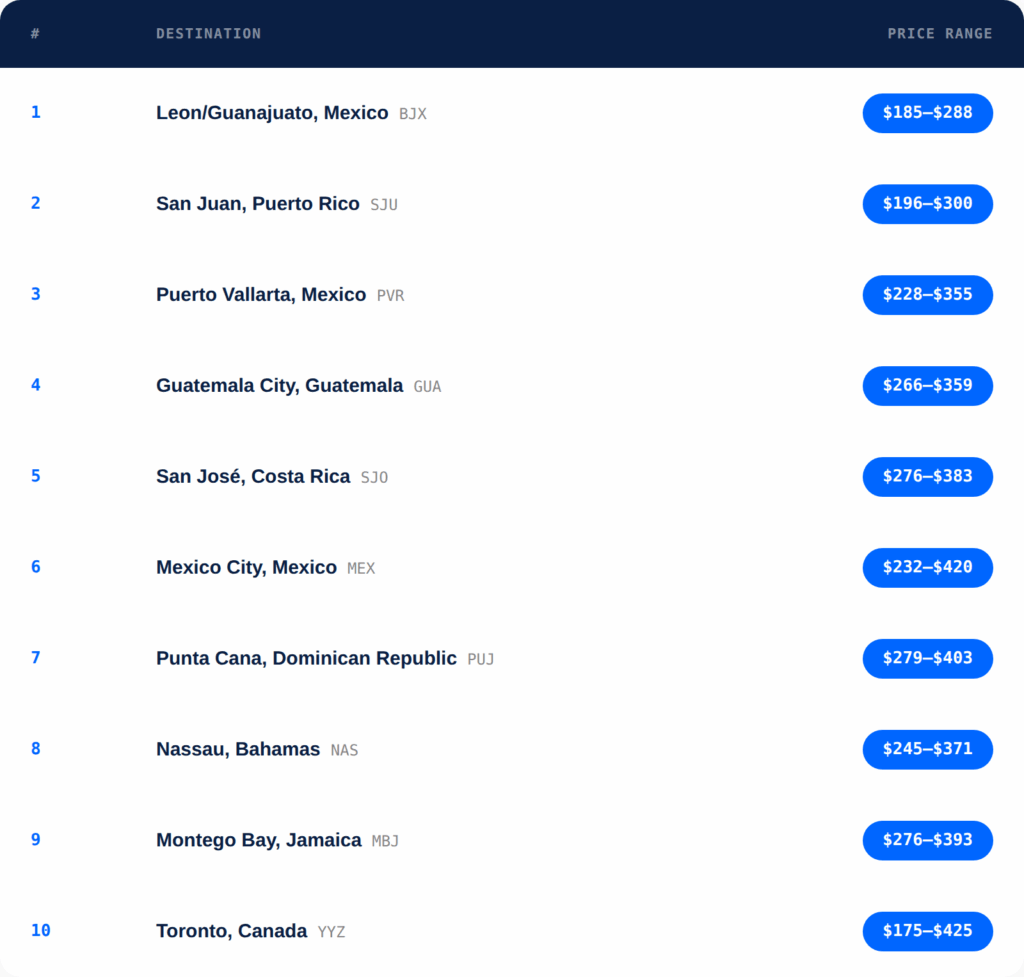
Latin America and the Caribbean are carrying the summer. Mexico, Puerto Rico, Costa Rica, Jamaica, and the Dominican Republic all produced consistent sub-$400 roundtrips from a wide range of U.S. cities. These routes are holding because they’re short, dominated by low-cost carriers, and insulated from the fuel pressure hitting transatlantic flights. Canada deserves a call-out this year. Toronto, Montreal, Vancouver, and Calgary are all showing sub-$400 summer fares, which makes them a double win: cheaper international trip and cooler weather than most U.S. cities. We analyzed pricing data across 65+ U.S. departure airports to build this list. Rankings are based on how often deals showed up for each destination and the lowest roundtrip economy fares we saw.
4. Top 10 Most Affordable Summer European Destinations for US Travelers
Key Takeaways
Europe is expensive this summer. I want to be upfront about that before getting into the list. Peak summer fares to the big Western European cities (Paris, Rome, London, Barcelona, Frankfurt) are running $1,700 to $2,100 roundtrip. That’s about 20% higher than last year. The fuel crisis is a big part of it, but demand hasn’t cooled either, which gives airlines no reason to discount. That said, deals are out there if you go north. Reykjavik, Dublin, and Stockholm are producing the highest volume of reasonable fares right now, with low-end prices in the $350-$500 range for early-season travel. Eastern Europe (Prague, Budapest, Vienna) is showing the occasional sub-$600 fare but with much thinner availability. And if you can shift to late August, almost every European city gets 30-40% cheaper. We ranked this list by deal frequency and lowest roundtrip economy fares. We focused on destinations with consistent deal volume rather than one-off flash sales, since one cheap fare to Venice doesn’t make Venice affordable.
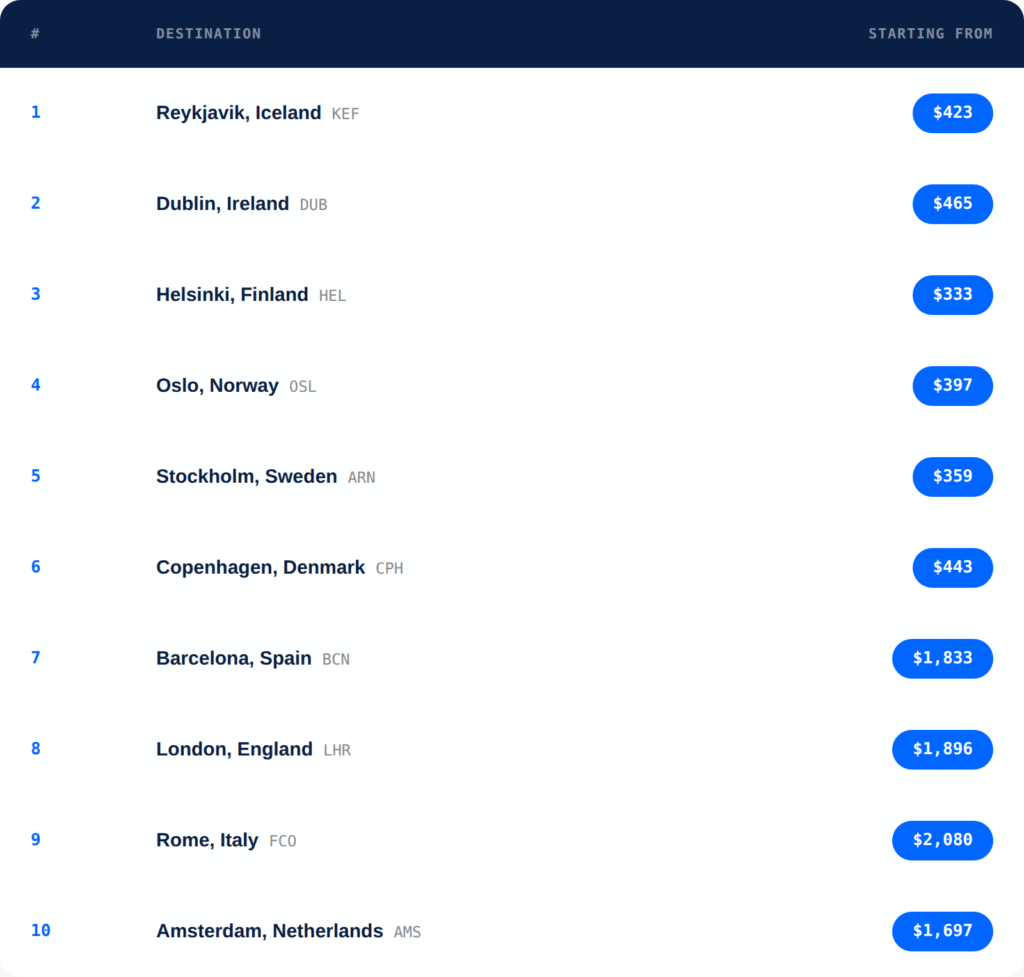
One note on these fares. Northern European cities are producing the best values because low-cost carrier service to those routes is still strong and they’re slightly shorter flights than Mediterranean routes. Western and Southern Europe are showing deals too, but the floor is much higher. If Italy, France, or Spain is the goal, shifting your trip to late August will save you 30-40% off these numbers.
5. Top 10 Most Affordable Summer Domestic Destinations for US Travelers
Key Takeaways
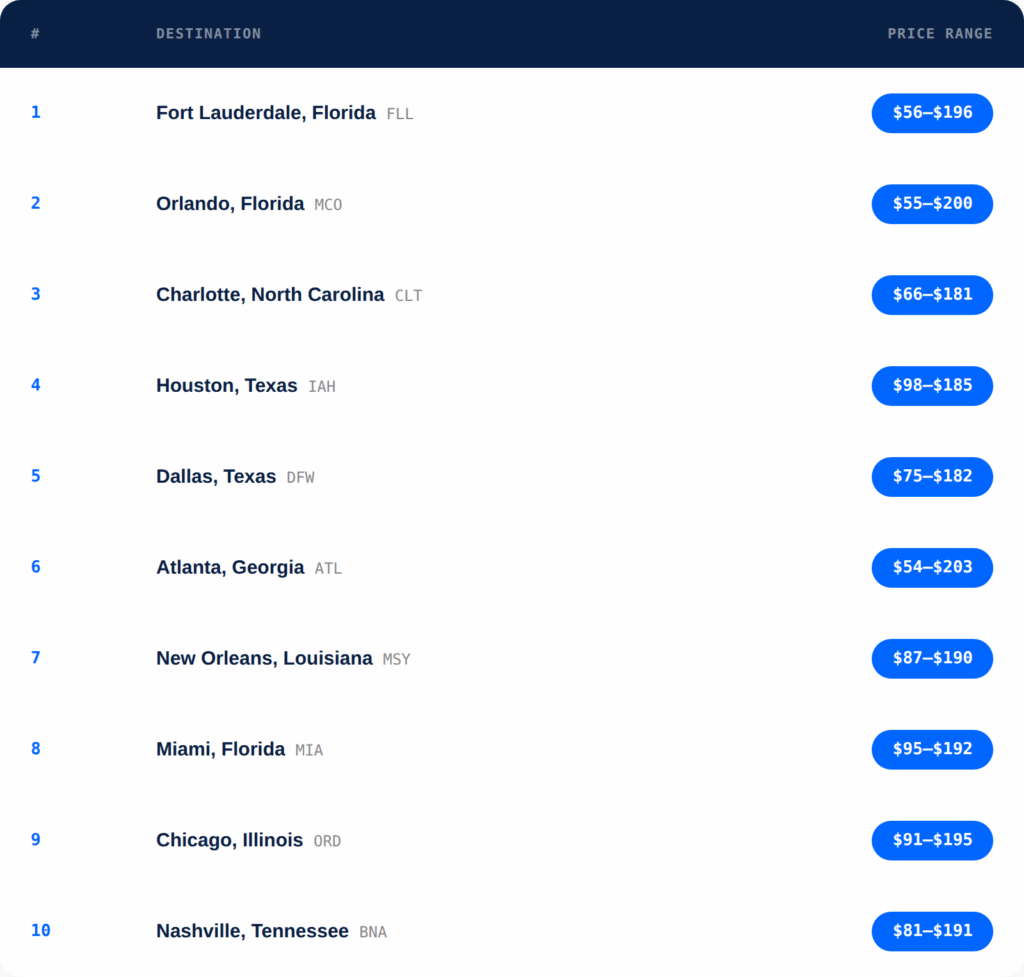
Domestic travel is the safety net this summer. Florida is the standout: Fort Lauderdale and Orlando are consistently under $150 roundtrip from a long list of East Coast and Midwest cities, which is about as cheap as it gets. The Texas hubs (Dallas, Houston) are right behind them. West Coast destinations are a different story. LAX, San Francisco, and San Diego are producing some deals, but at higher averages ($335-$373). The real domestic value this summer sits in the Southeast, Gulf Coast, and Midwest. If you’re on a tight budget, fly east, not west. Spirit’s May 2 shutdown will likely impact pricing in several of these markets, particularly Fort Lauderdale and Orlando, which were major Spirit hubs. Airlines have offered temporary rescue fares around $200 for stranded passengers, but we expect baseline prices on former Spirit routes to rise 20-25% within 3-6 months as budget carriers work to backfill capacity.
6. Top 5 Most Affordable Beach Destinations for Summer 2026
Key Takeaways
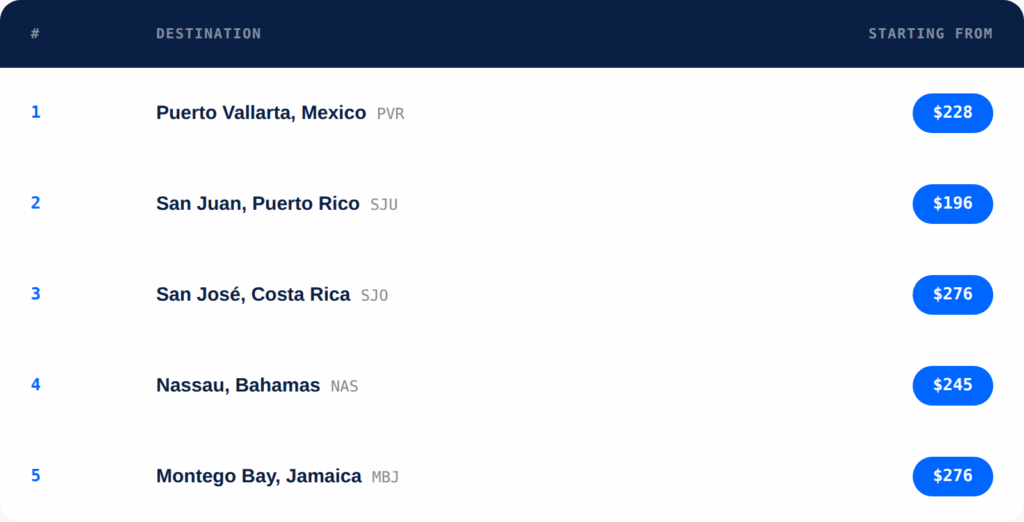
If you want a beach trip this summer, Mexico and Puerto Rico are the obvious picks. Puerto Vallarta and San Juan both have sub-$300 low-end fares, roughly 30-40% cheaper than flying to Hawaii. Cancun and the Dominican Republic round out the list, both under $400 on the low end despite being peak summer destinations. Quick note on hurricane season. It officially runs June through November, which is exactly why Caribbean fares are cheaper in summer than in winter. June and early July storm risk is genuinely low. August and September are when it starts picking up. If you’re booking a Caribbean trip this summer, trip insurance is worth the small extra cost.
7. Top 5 Most Affordable “Cool-cation” Destinations
Key Takeaways
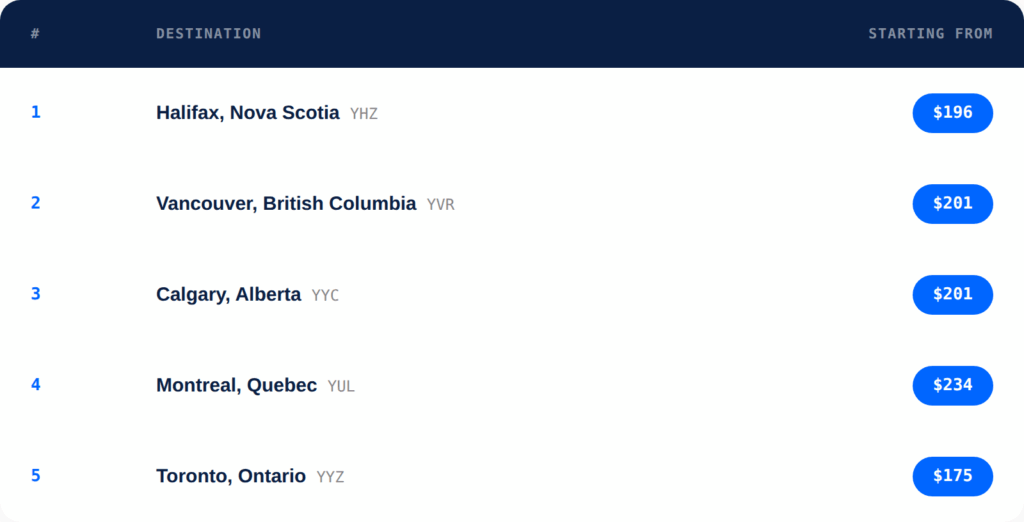
Cool-cations are having a real moment this summer. Two reasons for that. The first is obvious: summers keep getting hotter and travelers are actively looking for places they won’t be cooking on the sidewalk. The second is less obvious but equally important: a lot of the best cool-cation destinations (Canada, the Pacific Northwest, Alaska) are also among the cheapest international and domestic fares we’re seeing right now. That’s a rare overlap and it’s worth taking advantage of. Canada is the standout. Halifax, Vancouver, Toronto, Montreal, and Calgary are all showing sub-$400 summer fares. You get a passport stamp, cooler weather, and a reasonable flight cost all in one trip. Seattle and Portland are the domestic equivalents if you want to keep things simple.
8. Top 10 Tips for Scoring the Best Summer Travel Deals
Summer 2026 will reward flexibility and punish locked-in plans. These are the moves that matter most this year.
- Book now, not later. Airlines are cutting capacity every week. Fares aren’t going to get cheaper in most markets. If you see a deal, book it. The 24-hour cancellation rule gives you a safety net if something better comes along.
- Be flexible on where you go. This is the biggest money-saver available this year. A family of four flying to San Juan in June will spend around $800 total on flights. That same family flying to Europe is looking at closer to $5,200. That’s $4,400 in savings, or a week of hotels, food, and activities on the other side.
- Be flexible on when you go. Midweek departures are still 15-25% cheaper than Fridays and Sundays. Late August is about 20% cheaper than late June. Small shifts add up to hundreds of dollars per ticket.
- Be flexible on where you fly from. If you live within driving distance of more than one airport, check all of them. Fort Lauderdale and Orlando consistently produced international fares $100-$150 cheaper than Miami in our data. Baltimore regularly beat DC. Midway beat O’Hare. A 45-minute drive is usually worth a few hundred bucks.
- Use fare alerts. Prices are moving fast this year. Dollar Flight Club sends alerts when fares drop significantly, which is how most of our members catch the best deals. Google Flights is also solid for tracking specific routes.
- Consider alternative arrival airports. Flying into Milan instead of Rome or Brussels instead of Amsterdam can save hundreds of dollars. A train or budget flight to your actual destination is usually cheap.
- Book main economy, not basic economy. With fares moving this fast, you want the flexibility to rebook if prices drop. Main economy gives you that. Basic economy doesn’t.
- If Europe is the goal, wait. Push the trip to September or October. Fares drop 40-60%, crowds thin out, and the weather is honestly better.
- Watch the post-Spirit pricing landscape. Spirit’s shutdown removed competitive pressure on routes to Florida, Las Vegas, and the Caribbean. Budget carriers like Frontier, Allegiant, and Breeze are expected to expand into Spirit’s markets over the next few months, but near-term capacity is tighter and fares may run higher than usual on those routes.
- Use your miles. Cash fares are elevated, so miles are worth more than usual. Award availability has tightened, but on most international routes the math still works in your favor.
9. Methodology
To compile this report, Dollar Flight Club analyzed airfare data from multiple trusted sources, including airline partners, online travel agencies, major flight search engines, and internal deal-tracking systems.
We monitored hundreds of thousands of airfare routes across 65+ U.S. departure airports, evaluating seasonal trends, historical averages, and real-time pricing to surface the best-value destinations. For this report, we focused on round-trip economy fares for travel during Summer 2026 (June through August), collected through April 24, 2026.
All listed fares represent the lowest round-trip economy prices identified during our research window. Prices may vary based on demand, availability, and booking date. Year-over-year comparisons reference internal 2025 pricing data and publicly reported IATA and airline fuel cost figures.
Major departure airports included New York (JFK/EWR/LGA), Chicago (ORD/MDW), Boston (BOS), Atlanta (ATL), Miami/Fort Lauderdale (MIA/FLL), Dallas (DFW), Houston (IAH/HOU), Denver (DEN), Los Angeles (LAX), San Francisco (SFO), Seattle (SEA), Las Vegas (LAS), Philadelphia (PHL), Washington (DCA/IAD/BWI), and others.