Flying can get expensive, especially with airlines charging $35–$40 for a single checked bag on domestic routes. But you don’t need elite status to save money. Here’s how you can avoid baggage fees:
- Know Airline Rules: Check baggage fees, size, and weight limits before booking. Some airlines charge more for overweight or oversized bags.
- Stick to Carry-Ons: Pack efficiently using lightweight luggage, rolling clothes, and tools like packing cubes. Wear bulky items on the plane.
- Use Credit Cards: Airline-branded cards often waive bag fees for you and companions.
- Upgrade Fares: Main Cabin or premium tickets often include free checked bags. Compare costs to see if upgrading saves money.
- Gate-Check Bags: Volunteer to gate-check your carry-on on full flights, avoiding standard fees.
- Ship Luggage: Services like ShipGo can be cheaper for oversized or extra bags.
- Travel Smart: Share items with companions or redistribute weight to avoid fees.
Know Your Airline’s Baggage Rules
Getting familiar with your airline’s baggage policy before booking can help you dodge those surprise fees at the airport. A quick review of baggage fees, size limits, and weight restrictions can save both time and money.
Baggage Fees & Limits
For most major U.S. airlines, expect to pay $35 to $40 for your first checked bag and $50 to $100 for the second. If you’re flying with budget airlines like Frontier or Spirit, be aware that their fees vary depending on your route and booking time, ranging from $55 to $100. Some airlines, like United and American, offer a small perk: prepay online at least 24 hours before your flight to shave $5 off per bag.
When it comes to size, standard checked bags must stay within 62 linear inches (length + width + height) and weigh no more than 50 pounds for economy passengers on major airlines. However, budget carriers like Spirit and Frontier are stricter, capping the weight at 40 pounds. Exceeding these limits can get pricey – overweight bags (51–70 pounds) will cost you $100, and oversized ones (63–80 linear inches) come with a hefty $200 fee. A portable luggage scale can be a lifesaver here.
United Airlines takes a stricter approach with its Basic Economy fares. Unlike American, Delta, and JetBlue, which allow a full-size carry-on even for Basic Economy passengers, United only permits a personal item (about 9 x 17 x 10 inches). If you bring a full-size carry-on to the gate, you’ll face a $25 gate handling fee on top of the regular checked bag fee – totaling $65.
How Fare Types Affect Baggage Allowances
Your ticket type plays a big role in determining what you can bring without extra charges. For most major airlines, Main Cabin or standard economy fares include one personal item and one carry-on, but you’ll still pay for checked bags. Basic Economy, however, is where things get tricky. While American, Delta, Alaska, and JetBlue allow both a carry-on and a personal item, United limits Basic Economy passengers to just a personal item. Budget carriers like Spirit and Frontier charge for anything larger than a personal item.
If you upgrade to Premium Economy, Business, or First Class, you’ll typically get two to three free checked bags, often with higher weight limits of up to 70 pounds per bag. On long-haul international flights, standard economy fares often include one free checked bag – though Basic Economy passengers on those same routes still have to pay, usually around $75 with airlines like American or United.
Airlines That Offer Free Checked Bags
As of May 28, 2025, Southwest Airlines ended its long-standing policy of free checked bags. Now, most Southwest passengers must pay for checked luggage, though those with a Southwest credit card still get one free bag. This change leaves few options for travelers seeking free checked bags without elite status or a credit card.
The best opportunities for free checked bags are on international flights in standard economy to destinations like Europe, Asia, or Australia, where many major airlines still include one or two free checked bags. Alaska Airlines offers an interesting exception: passengers can check ski or snowboard equipment, or even a case of wine from certain regions, at no extra cost. For domestic flights, avoiding checked bag fees usually requires elite status, a co-branded airline credit card, or a premium cabin ticket.
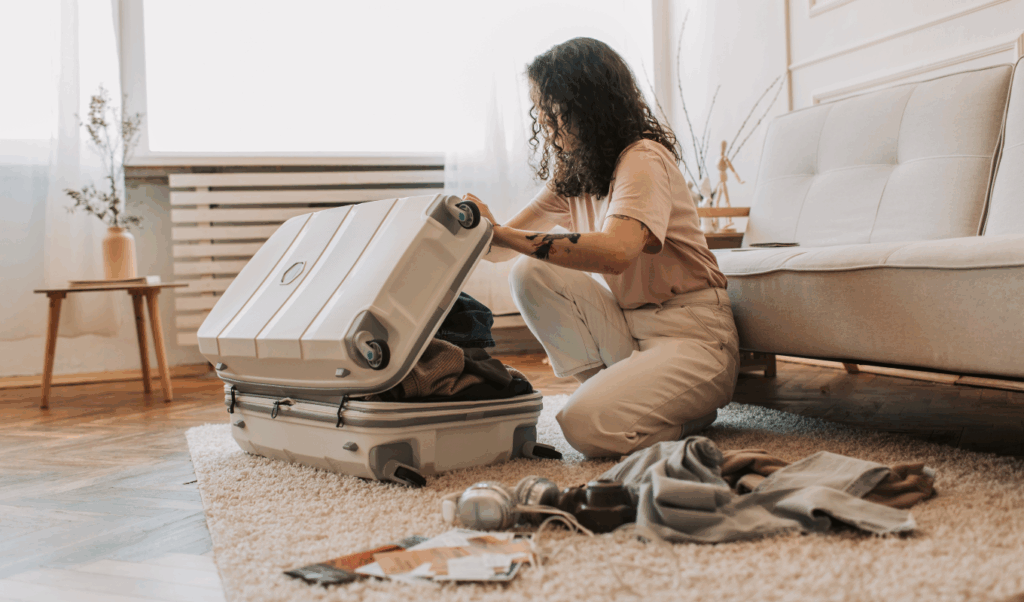
Pack Smart to Avoid Checked Bags
Want to skip baggage fees? The easiest way is to stick to a carry-on. With the right suitcase and some clever packing strategies, you can pack everything you need for a week-long trip – no checked bags required. By understanding airline rules and maximizing your carry-on space, you can save both money and hassle.
Pick the Right Carry-On Luggage
Start with a lightweight, durable carry-on that meets U.S. airline size restrictions. To ensure your bag is compliant, measure it from the base to the highest point with the handles retracted. Keep in mind that empty carry-ons can weigh anywhere from 4 to 8 pounds, so going for a lighter option gives you more room for your belongings.
Don’t forget about your personal item. Most airlines allow a second bag that fits under the seat in front of you. For instance, American Airlines typically allows personal items up to 18 x 14 x 8 inches, while JetBlue’s limit is 17 x 13 x 8 inches. A roomy backpack or laptop bag works well for keeping essentials like electronics and documents within reach during the flight.
Packing Tips for Carry-On Only Travel
Packing smart is the key to fitting everything into a carry-on. Rolling your clothes instead of folding them can save space, especially for items like T-shirts, pajamas, and shorts. Packing cubes are another great tool – they help keep things organized and make it easy to see what you’ve packed. If something doesn’t fit into your packing cubes, it’s probably not essential.
Vacuum-seal bags can also help compress bulky clothing, freeing up even more space.
Follow the 10‑$10 Rule: if you can buy an item at your destination in 10 minutes for under $10, leave it at home. For trips longer than a week, pack just 4 to 5 days’ worth of clothes and plan to use hotel laundry services or local laundromats. Choose quick-drying fabrics that can work for multiple uses, and don’t forget the TSA’s 3‑1‑1 rule for liquids: each container must be 3.4 ounces or less, and all liquids must fit into a single quart-sized clear bag.
Carry-On Tricks to Maximize Space
One clever trick is to wear your bulkiest items on the plane. Boots, heavy jackets, and thick sweaters don’t count toward your baggage allowance when worn. Another hack? Use a stuffable neck pillow that doubles as extra storage. Some of these can hold up to two days’ worth of clothing, and they typically don’t count against your luggage limit – unless you’re flying with an ultra-low-cost carrier.
If you’re running out of space, consider in-flight strategies to stretch your baggage allowance. For example, if the overhead bins are full when you board, you can volunteer to gate-check your carry-on. Airlines often do this for free, letting you avoid standard checked bag fees without the hassle of checking your luggage at the counter.

Use Credit Cards and Fare Upgrades for Free Bags
Beyond knowing airline baggage policies and packing efficiently, using certain credit cards or upgrading your fare can significantly reduce or even eliminate baggage fees. The right financial tools can save you hundreds of dollars in fees, while fare upgrades can make paying for bags a thing of the past.
Airline Credit Cards That Waive Bag Fees
Many co-branded airline credit cards offer free checked bags for the primary cardholder and, in some cases, their travel companions on the same reservation. The specifics vary: some cards extend the benefit to several companions, while others only cover one.
For airlines like Delta, American, Southwest, and JetBlue, you’ll need to link your frequent flyer number to your reservation to activate the free bag benefit. On the other hand, United and Alaska Airlines require you to pay for your ticket – or at least the taxes and fees on award flights – using the co-branded card to qualify for the fee waiver. If you book through a third-party site or use a different card, you won’t be eligible for this perk.
These credit cards typically charge annual fees ranging from $95 to $150, though many waive the fee for the first year. Considering that most airlines charge $35 to $40 for a single checked bag on a one-way flight, these cards can quickly pay for themselves.
When Fare Upgrades Save Money on Bags
Fare upgrades can also be a clever way to avoid baggage fees. If the combined cost of a Basic Economy ticket and its associated bag fees is close to the price of a Main Cabin fare, upgrading can save you money.
This tactic is especially useful on United Airlines, where Basic Economy passengers aren’t allowed a full-size carry-on. Upgrading to a higher fare class not only avoids bag fees but also eliminates potential gate handling charges.
For travelers checking multiple bags, premium cabin upgrades can provide even greater savings. Domestic flights often charge $150 for a third checked bag, and overweight fees can start at $100 for bags between 51 and 70 pounds. First Class and Business Class tickets, however, typically include two to three free checked bags with a higher weight limit of 70 pounds instead of 50 pounds.
On Alaska Airlines, upgrading from a Saver fare to Main Cabin often costs between $15 and $30 each way, which can be cheaper than the $35 fee for checking a single bag. Similarly, budget airlines like Frontier offer bundled fares that include both a carry-on and a checked bag for less than the cost of adding them individually.
Other Ways to Avoid Baggage Fees
Beyond packing efficiently and leveraging credit card perks, there are a few additional strategies to help you dodge those pesky baggage fees.
Volunteer for Free Gate-Check
If you’re on a flight with limited overhead bin space, there’s a good chance the airline will ask for volunteers to gate-check their carry-on bags at no extra cost. This can save you the usual $30–$40 fee for a checked bag on major airlines. Gate agents typically make these announcements during the boarding process when the bins start filling up, so keep your ears open.
Before handing over your bag, make sure to transfer essential items like medications, lithium batteries, and valuables into your personal item since these aren’t allowed in the cargo hold. Also, confirm with the gate agent whether your bag will be checked all the way to your final destination or if you’ll need to pick it up at the jet bridge – this is common on smaller regional flights.
Keep in mind, however, that if you’re flying Basic Economy with airlines like United or JetBlue, you might face extra fees at the gate. This tactic is best suited for passengers with standard economy tickets. If gate-checking doesn’t work for your flight, there are other creative ways to cut down on baggage costs.
Ship Your Luggage Instead of Checking It
For oversized, heavy, or additional bags, shipping your luggage directly to your destination can be a cheaper alternative. Services like ShipGo (starting at $34.99) and LugLess offer door-to-door delivery with tracking included.
This approach is particularly useful when the airline’s extra bag fees are higher than shipping costs. For example, Delta charges $150 and Alaska Airlines charges $100 for a third checked bag. By comparison, shipping a 50-pound bag from San Francisco to Las Vegas via FedEx Ground costs around $50, which is far less. Plus, ShipGo includes $500 of insurance for standard luggage and $1,000 for sporting equipment.
Another smart move is to ship souvenirs home after your trip. This can help you avoid overweight fees, which can range from $75 to $200 per bag.
Split Items Among Travel Companions
Traveling with others? Redistributing items among your group can help you avoid excess baggage fees. For instance, if one person’s bag is over the 50-pound limit at check-in, moving a few items to another companion’s lighter bag can save you from paying overweight charges.
This tactic works especially well if someone in your group has perks like free checked bags through elite status or an airline credit card. For example, Delta’s co-branded credit cards provide free first bag benefits for up to nine people on the same reservation, while Alaska Airlines cards extend the same benefit to six companions.
Some airlines even allow baggage pooling, where passengers on the same reservation can combine their weight allowances. To take advantage of these perks, make sure everyone checks in together at the counter. And to avoid last-minute surprises, weigh your bags at home with a digital scale to see who has extra room.
Mistakes That Cost You Extra Baggage Fees
Even seasoned travelers can find themselves hit with unexpected baggage fees if they’re not fully aware of airline rules. Here’s a breakdown of common missteps and how to sidestep them.
Not Knowing Basic Economy Rules
Basic Economy fares are notorious for their strict baggage policies, which vary by airline. For instance, Alaska, American, Delta, and JetBlue allow a free carry-on bag in Basic Economy. But United Airlines? They only let you bring a personal item (9 x 17 x 10 inches) that fits under the seat. If you show up with a full-size carry-on on a United Basic Economy ticket, you’ll face both the standard checked bag fee and a $25 gate handling fee – totaling around $65.
Budget airlines like Spirit and Frontier are even stricter, only permitting a personal item and charging extra for any carry-on luggage. To avoid these charges, always check your airline’s baggage policy before packing. And if you think that’s all, exceeding size and weight limits can make things even pricier.
Exceeding Size and Weight Limits
Overpacking can lead to painful fees. Most major airlines set a 50-pound limit for checked bags, but Spirit and Frontier cap it at 40 pounds. If your bag weighs between 51 and 70 pounds, you could face overweight fees starting at $100 on United. American Airlines has introduced a tiered system, charging about $30 for bags just over the limit (50–53 pounds) and up to $450 for the heaviest ones.
Carry-on dimensions matter too. The standard size is usually 22 x 14 x 9 inches. If your bag doesn’t fit within these limits or fails the sizer check, you’ll have to check it at the gate, where fees are much steeper. To avoid this, weigh your bags at home using a digital scale. If one bag is too heavy, shift items to a companion’s lighter bag or move heavier essentials into your carry-on. U.S. airlines rarely enforce weight limits for carry-ons in overhead bins. Planning ahead can save you from paying more than you need to.
Waiting to Pay for Bags at the Airport
Paying for baggage at the airport is one of the most expensive mistakes you can make. Airlines use tiered pricing, and fees climb as your departure gets closer. For example, Spirit Airlines charges about $34 for a checked bag if you pay during booking, but that skyrockets to $99 at the gate. Even traditional carriers like American Airlines charge more – around $35 online versus $40 at the airport counter.
The key to saving money? Pay for your bags when you book your ticket or through the airline’s app well before check-in. Booking baggage fees early is almost always cheaper than waiting until the last minute. In 2022, travelers collectively spent about $6.8 billion on baggage fees – a cost that could often be minimized with better planning.
Conclusion
Dodging checked bag fees without elite status is entirely possible when you use the right strategies. Start by familiarizing yourself with your airline’s baggage policies – know which carriers offer free bags, what your fare type includes, and the specific size and weight limits. This knowledge alone can help you save hundreds of dollars over time.
Smart packing is another essential tactic. Choose luggage that meets carry-on requirements, make the most of your carry-on space, and wear your bulkiest items to free up room in your bag. If you need to check a bag, consider using an airline credit card that waives these fees or a premium travel card offering annual credits to cover the cost. And when the combined price of a Basic Economy fare and bag fees gets close to a Main Cabin fare, upgrading could save you money while giving you extra perks.
Other tricks, like taking advantage of free gate-checking or redistributing items with travel companions, can also help you avoid fees. If you do need to pay for a checked bag, be sure to do it when booking your ticket – airport fees can climb from around $35 to as much as $99.
FAQs
What are the best ways to pack efficiently and avoid checked bag fees?
Packing smartly can save you from paying for checked bags. The key is to make the most of your carry-on and personal item. Start with a lightweight carry-on that fits within airline size restrictions – usually 22 × 14 × 9 inches. To maximize space, use packing cubes or compression bags, and roll your clothes instead of folding them. Wear your bulkiest shoes and outerwear during the flight to free up space in your bag.
Every inch counts, so tuck small items like socks, chargers, and toiletries into shoes or any empty spaces. Stick to versatile clothing and limit yourself to two pairs of lightweight shoes. For your personal item, go with a backpack or tote that fits under the seat. Pack essentials like electronics, travel documents, and a change of clothes in it. Before heading to the airport, do a quick test to ensure your bags meet size and weight limits – this can help you avoid any last-minute fees.
Which credit cards let you check bags for free without having elite status?
Many credit cards come with the perk of free checked bags, even if you’re not an elite airline status holder. Cards like the Delta SkyMiles® Gold American Express Card, United Explorer Card, and American Airlines AAdvantage® MileUp Card offer at least one free checked bag for the cardholder – and sometimes even for their travel companions.
If you regularly fly with a particular airline, these cards can help you cut down on baggage fees. Just make sure to review the terms and conditions to fully understand the benefits and any limitations that might apply.
Is upgrading my ticket cheaper than paying for checked bags?
Sometimes, upgrading your ticket can actually save you money compared to paying for checked bags separately – it all comes down to the upgrade price. Checked bag fees usually fall between $30 and $35 per bag, but many first-class or business-class tickets include free checked luggage. If the upgrade costs less than what you’d spend on baggage fees, it could be a smarter choice. Always compare the numbers to see what works best for your budget.