
I book smarter when I track prices early, set alerts, and buy when the fare drops near the low end of its recent range.
Here’s the short version:
- I start tracking domestic flights 1 to 3 months out
- I start tracking international flights 3 to 6 months out
- I avoid waiting until the last 14 days, when domestic fares can cost about 25% more
- I use specific flight alerts for fixed plans and flexible date alerts when I can shift my trip
- I compare today’s fare to the route’s 90-day price range
- I book when the price is in the bottom quarter of that range or when a mistake fare shows up
This works because airline prices change all the time. So I don’t try to guess the “best day” to book. I watch the route, learn its normal price, set a target, and act when the fare gets low enough.
If I want the simplest plan, it looks like this: track early, set alerts, watch the trend, and book when the price hits my range.

Start tracking early and set the right alerts
Now that you know why timing matters, the next move is simple: start tracking early and set alerts. Early tracking gives you a feel for a route’s normal price range before fares start bouncing around.
How far in advance to track domestic vs. international flights
For domestic flights, start tracking 1 to 3 months before departure. That’s usually the sweet spot, and booking within the recommended 34–86 day window saves an average of 25%. People who book domestic flights more than 6 months ahead pay an average of $160 more than travelers who wait for that 1–3 month window.
For domestic trips, start tracking 1 to 3 months before departure. For international trips, start 3 to 6 months ahead.
Holiday travel needs an earlier start. Track Thanksgiving flights by mid-October, Christmas flights by Halloween, and summer travel 4 to 10 months ahead.
How to set up fare alerts for a specific route or flight
Set alerts for the route and dates you care about so you’ll know when prices move.
Use specific-flight tracking if your plans are fixed. Use route tracking if your dates can shift a bit. Kayak, for example, has a Track Prices box with options for Exact Dates, Flexible Dates, or Top 25 Cities.
Use flexible dates to find lower fares
If your schedule has some wiggle room, flexible date tracking is one of the best ways to find a lower fare. Instead of locking yourself into one departure and return date, you watch a range of dates and use the price calendar to spot the cheapest combination. Tools like Google Flights make this process much easier.
Here’s a simple breakdown of when each tracking option fits best:
| Tracking Type | Best Use Case | Level of Flexibility | When to Choose |
|---|---|---|---|
| Specific Flight | Fixed plans like weddings or business meetings | Low | When you must be on a particular flight for timing or airline preference |
| Specific Route | General vacations to a set destination | Moderate | When you know where you’re going but can shift dates by a few days |
| Flexible Dates | Budget-first travelers seeking the best deal | High | When the destination matters more than the specific travel dates |
Once your alerts are live, the next step is reading the price history graph so you can tell whether today’s fare is low or just looks low.
How to read a price history graph
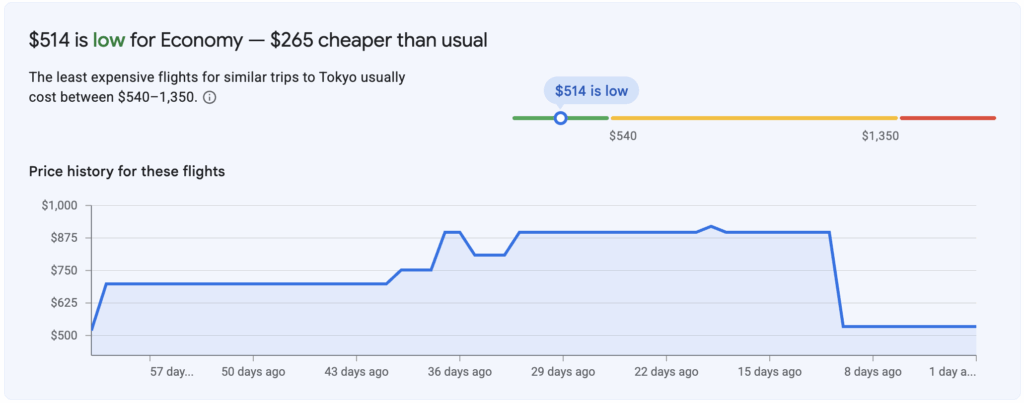
A price history graph shows where today’s fare sits compared with the route’s usual range. That helps you judge whether the current price is a deal or just looks cheap at first glance.
The main idea is simple: compare today’s fare with what that route has done over time, not just with the number you see on the page.
How to tell if today’s fare is high, normal, or low
If the current price falls in the lowest quarter of the route’s 90-day range, that’s often a strong sign to book.
| Pricing Level | Meaning | Recommended Action |
|---|---|---|
| Low | Bottom quarter of 90-day range | Book now; fares rarely drop further. |
| Typical | Near the median for the route | Wait and track if dates are flexible. |
| High | Top quarter of 90-day range | Wait; set fare alerts and check nearby airports. |
Don’t judge the fare by the headline price alone. A $250 ticket might look cheap, but if that route often sells for $180, it’s not much of a deal. On the other hand, a $400 fare can be worth taking if the route usually runs much higher.
Price level tells you where the fare sits right now. Trend tells you where it seems to be going.
What downward and upward price trends usually mean
If fares are moving down, it can make sense to wait a bit longer. If prices start to flatten or move up, the deal may be slipping away. Domestic fares often jump hard starting about two weeks before departure as last-minute demand goes up.
So think of predictions as a guide, not a rule. They can point you in the right direction, but they can’t promise what a fare will do next.
Use those trend signals to help decide whether to book now or keep waiting.

How to decide whether to book now or wait
Tracking a route gives you data. But sooner or later, you still have to make the call.
The point isn’t to hold out for the lowest price in history. It’s to spot a fare that’s good enough and grab it before it vanishes. Once you’ve seen the pattern on a route, a few clear signals can help you decide fast.
Signs the fare is good enough to book now
The best signal is simple: the fare drops near the bottom of its recent range.
If the current price sits at the low end of what you’ve been seeing and comes in well below the route’s usual price, that’s often the moment to book. In practice, price movement matters more than the calendar. A fare that falls into a range that’s clearly below the route’s usual median is a strong cue to act.
Warning signs a deal is about to disappear
Mistake fares are the easiest example. These usually come from pricing errors, and they can disappear within hours. If you see one, book right away.
Another red flag is a fare that starts moving up during peak travel periods. Peak summer fares in 2026 are up 24% year-over-year, so if you’re watching a summer route that’s already trending upward, waiting can mean paying more.
| Signal | Action | Reasoning |
|---|---|---|
| Fare lands near the bottom of its recent range | Book now | Prices at this level are uncommon and may not last. |
| Mistake fare alert | Book immediately | These errors are often corrected by airlines within hours. |
| Prices are rising during peak travel periods | Book now | The deal may disappear as demand increases. |
If manual tracking feels like a chore, automated alerts can watch the route for you.

Use automated deal alerts and follow a simple booking plan
How email and SMS deal alerts replace manual checks
If you already know your target fare, let alerts handle the route for you.
Flight deal alert services send an email or text when a discounted fare shows up on a route you’ve been watching. That means you don’t have to keep checking prices by hand. You just compare the fare to your target, look at the route’s usual price range, and book if it drops low enough.
Why Dollar Flight Club works for travelers who want less effort
If you want a more hands-off option, Dollar Flight Club can do the heavy lifting.
It sends email and SMS alerts for discounted domestic and international flights, with some deals up to 90% off. Members also get access to travel perks and discounts from top travel brands.
FAQs
What if flight prices never drop?
If prices don’t drop, the fare may already be close to its lowest point, or demand may still be high. So don’t count on a last-minute miracle. Prices often climb in the final three weeks.
A better move is to check midweek or off-peak dates, or look at nearby secondary airports. If you’ve already booked and the price drops later, check your airline’s policy for free changes or cancellations.
Should I book separate tickets to save money?
Yes, booking separate tickets for your outbound and return flights can often cost less than buying a standard round-trip fare. When you mix and match airlines for each leg, you may find lower prices than you’d get with a single round-trip ticket.
It’s smart to compare one round-trip fare against two separate one-way tickets before you book. Sometimes the split option wins. Sometimes it doesn’t. A quick side-by-side check can save you money.
Do baggage fees change what looks like the best deal?
Yes. Baggage fees can change the true cost of your trip. A flight that looks cheaper at first can end up costing more once you add bag fees.
Checked bags often cost $30 to $60 each way, so it makes sense to compare fares with those extra charges included. Some tracking tools also offer fee assistants that help estimate the total cost.